
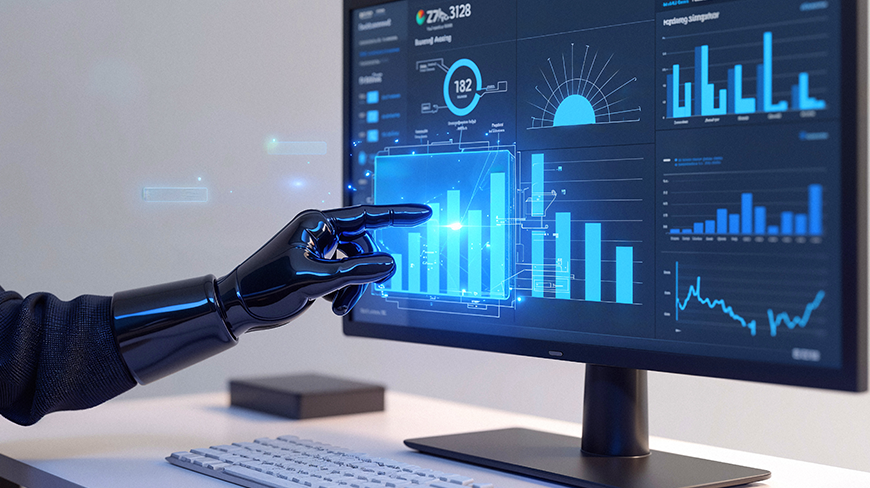
In today's digital economy, businesses generate enormous amounts of data every day. Managing this data manually is no longer practical, which is why Enterprise Resource Planning (ERP) systems have become essential. However, traditional ERP solutions are evolving rapidly with the integration of Artificial Intelligence (AI), making them smarter, faster, and more efficient than ever before.
AI-powered ERP systems are transforming how organizations automate operations, predict business trends, optimize resources, and make data-driven decisions. Rather than simply storing and organizing business information, modern ERP software now acts as an intelligent business assistant that continuously learns and improves.
At PiERP , we combine advanced ERP capabilities with intelligent automation to help businesses streamline operations, improve productivity, and accelerate digital transformation.
What is AI in ERP?
Artificial Intelligence in ERP refers to the integration of technologies such as:
- Machine Learning (ML)
- Natural Language Processing (NLP)
- Predictive Analytics
- Robotic Process Automation (RPA)
- Intelligent Data Processing
- AI-powered Chatbots
These technologies enable ERP systems to analyze large datasets, automate repetitive tasks, detect patterns, forecast outcomes, and provide actionable recommendations with minimal human intervention.
Why Modern Businesses Need AI-Powered ERP
Businesses today operate in highly competitive environments where quick decisions and operational efficiency are critical.
Traditional ERP systems provide historical reports, while AI-enabled ERP systems provide:
- Real-time business insights
- Intelligent forecasting
- Automated workflows
- Reduced operational costs
- Improved customer experiences
- Better inventory optimization
This shift transforms ERP from a record-keeping system into a strategic decision-making platform.
Key Ways AI is Revolutionizing ERP Systems
1. Intelligent Process Automation
One of the biggest advantages of AI is automating repetitive business tasks.
Examples include:
- Invoice processing
- Purchase order approvals
- Payroll processing
- Data entry
- Expense verification
- Report generation
Instead of requiring manual intervention, AI handles these tasks accurately and efficiently, allowing employees to focus on higher-value activities.
2. Predictive Analytics for Better Decision-Making
Traditional ERP systems analyze past performance.
AI-powered ERP systems predict future outcomes.
Using historical business data, AI can forecast:
- Sales demand
- Customer purchasing behavior
- Inventory requirements
- Production schedules
- Cash flow trends
- Equipment maintenance
These predictive insights help businesses make proactive decisions rather than reacting to problems after they occur.
3. Smarter Inventory Management
Inventory management is one of the most critical business operations.
AI improves inventory management by:
- Forecasting demand accurately
- Reducing stock shortages
- Preventing overstocking
- Optimizing warehouse operations
- Identifying slow-moving products
- Automating inventory replenishment
The result is reduced inventory costs and improved customer satisfaction.
4. Enhanced Customer Experience
Modern ERP systems integrate customer data across sales, marketing, finance, and support departments.
AI analyzes customer behavior to provide:
- Personalized recommendations
- Faster customer support
- Automated responses
- Customer sentiment analysis
- Sales opportunity predictions
Businesses can build stronger customer relationships while improving service quality.
5. Intelligent Financial Management
Finance teams spend considerable time reconciling accounts and preparing reports.
AI simplifies financial operations through:
- Automated bookkeeping
- Fraud detection
- Expense categorization
- Budget forecasting
- Cash flow predictions
- Financial anomaly detection
This reduces errors while improving financial accuracy and compliance.
6. AI-Powered Supply Chain Optimization
Supply chains are becoming increasingly complex.
AI helps organizations optimize supply chains by:
- Predicting supplier delays
- Identifying supply chain risks
- Optimizing transportation routes
- Forecasting demand fluctuations
- Managing procurement intelligently
This leads to better operational resilience and reduced logistics costs.
7. Predictive Maintenance
Manufacturing businesses can significantly reduce downtime using AI.
Instead of waiting for machines to fail, AI analyzes equipment performance and predicts maintenance needs before breakdowns occur.
Benefits include:
- Reduced downtime
- Lower repair costs
- Increased equipment lifespan
- Improved production efficiency
8. Natural Language Search & AI Assistants
Modern ERP platforms increasingly include AI assistants that allow users to interact with the system using natural language.
For example:
- "Show this month's sales."
- "Which products have low inventory?"
- "Generate a profit report."
This makes ERP software more user-friendly and reduces the learning curve for employees.
9. Better Risk Management
AI continuously monitors business operations to identify unusual patterns. It can detect:
- Fraudulent transactions
- Compliance violations
- Cybersecurity threats
- Financial irregularities
- Operational risks
Organizations can respond faster and reduce potential business losses.
10. Continuous Learning and Improvement
Unlike traditional ERP systems, AI learns from historical data and user interactions.
Over time, AI continuously improves:
- Forecast accuracy
- Process efficiency
- Workflow optimization
- Customer recommendations
- Business insights
This makes the ERP system increasingly intelligent as business data grows.
Benefits of AI-Powered ERP
Organizations implementing AI-enabled ERP systems experience numerous advantages, including:
- Increased operational efficiency
- Faster decision-making
- Reduced manual work
- Lower operational costs
- Higher employee productivity
- Improved forecasting accuracy
- Better customer satisfaction
- Enhanced business agility
- Real-time analytics
- Stronger competitive advantage
Industries Benefiting from AI ERP
AI-powered ERP solutions are transforming businesses across multiple industries, including:
- Manufacturing
- Retail & eCommerce
- Healthcare
- Logistics & Transportation
- Distribution
- Construction
- Education
- Hospitality
- Finance
- Professional Services
Each industry leverages AI differently, but all benefit from greater automation, efficiency, and actionable insights.
Why Choose PiERP for AI-Driven ERP Solutions?
At PiERP, we believe ERP software should do more than manage data—it should empower smarter decisions and business growth. Our platform is built to support organizations with intelligent features that automate routine tasks, deliver real-time insights, and improve operational efficiency.
Whether you're looking to modernize finance, streamline inventory, optimize supply chains, or gain predictive business intelligence, PiERP provides a scalable ERP solution tailored to your business needs.
Learn more about our platform on the PiERP Home Page , explore our ERP Solutions , discover our ERP Features , discover our Industry Solutions , and get in touch through our Contact Us page to discuss your business requirements.
Future of AI in ERP
The future of ERP is increasingly intelligent. As technologies such as Generative AI, advanced machine learning, and predictive analytics mature, ERP systems will become more autonomous and capable of making complex business recommendations.
Organizations adopting AI-powered ERP today will be better positioned to:
- Respond quickly to market changes
- Improve operational efficiency
- Enhance customer experiences
- Reduce costs
- Drive long-term business growth
Investing in AI-enabled ERP is no longer just a technology upgrade—it's a strategic step toward building a smarter, more agile enterprise.
Conclusion
Artificial Intelligence is redefining the capabilities of modern ERP systems by transforming them into intelligent platforms that automate operations, deliver predictive insights, and support faster, more informed decision-making. From finance and inventory management to customer service and supply chain optimization, AI empowers organizations to operate more efficiently and competitively.
PiERP is committed to helping businesses embrace this transformation with scalable, AI-ready ERP solutions designed for today's dynamic business environment. Whether you're beginning your digital transformation journey or enhancing an existing ERP implementation, PiERP can help you unlock the full potential of AI-driven enterprise management.